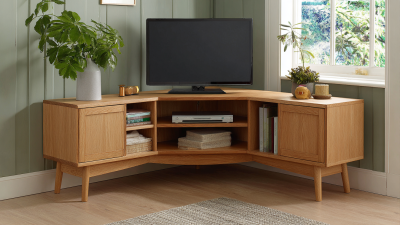
Why Choose a Small Oak Corner Unit for Global Sourcing?
Global furniture buyers increasingly value compact products that combine function, durability, and efficient transport. Grand View Research’s Furniture Market Size, Share & Trends Analysis Report, 2023–2030, forecasts steady global furniture growth at approximately 5.2% annually. This outlook supports demand for adaptable pieces, especially in urban homes where every corner matters. A Small Oak Corner Unit can use overlooked space beside a sofa, hallway, or kitchen wall. Its compact footprint may also improve carton efficiency and reduce unused container volume.
Oak remains attractive because it offers visible grain, reliable strength, and a familiar natural appearance. However, sourcing decisions require more than attractive photographs. Buyers should check kiln-drying standards, moisture content, panel construction, edge finishing, packaging tests, and FSC chain-of-custody documentation. The Forest Stewardship Council reports millions of hectares under certified forest management worldwide, but certification claims still require supplier verification. Small details matter. A warped shelf can damage customer trust.
William Morris, a major figure in furniture and design history, wrote in “The Beauty of Life” (1880), “Have nothing in your houses that you do not know to be useful, or believe to be beautiful.” That principle fits this product category well. A Small Oak Corner Unit should earn its space through storage, stability, and honest materials. It is not automatically the cheapest option. Thicker oak, stronger joinery, and protective packaging can raise costs. Yet reliable quality may reduce returns, replacements, and long-term waste. Global sourcing becomes more credible when buyers compare total landed cost, not only factory price. There is still room for improvement. Suppliers must test assumptions with samples, inspections, and real customer feedback.
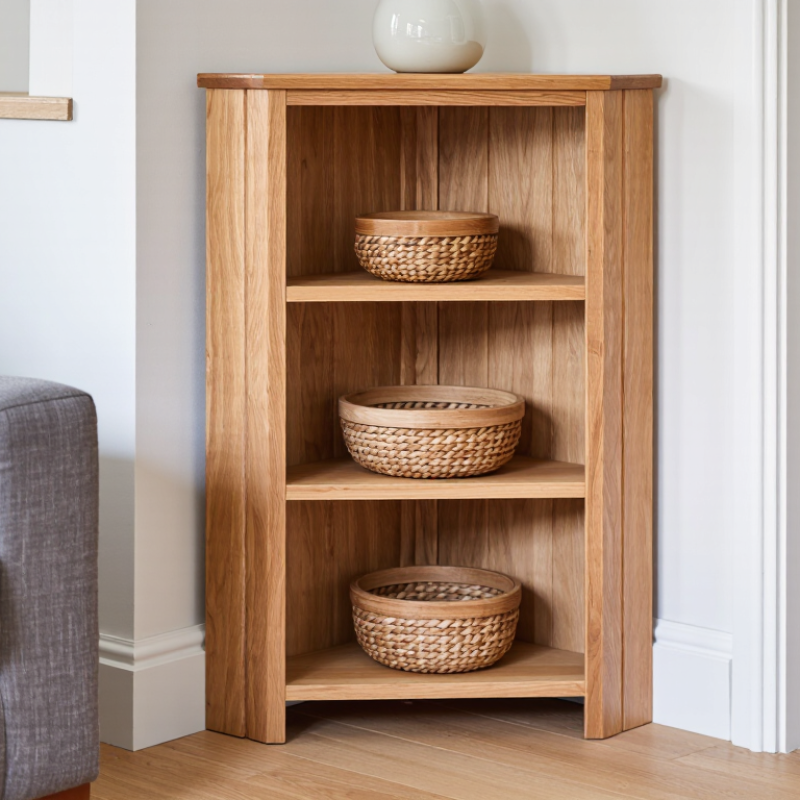
A small oak corner unit is a compact storage cabinet designed to fit into a room’s unused corner. Its rear edges usually meet at a right angle, while the front may be square, curved, or angled. Typical widths range from 600 to 900 millimeters, but no universal size exists. The term describes a function, not a fixed product standard.
Oak may appear as solid timber, oak veneer over engineered board, or a mixed construction. This distinction affects price, weight, movement, and repairability. Solid oak offers visible grain and strong joinery potential. Veneer can reduce material use and dimensional movement.
A reliable specification should state the oak species, board structure, moisture content, finish, hardware, and tested load capacity. Small details matter.
The Food and Agriculture Organization’s Global Forest Resources Assessment 2020 recorded 4.06 billion hectares of forest worldwide. It also reported about 420 million hectares lost since 1990. These figures make responsible timber documentation important during global sourcing. Suppliers should provide clear origin records and evidence of legally harvested wood.
Independent chain-of-custody documentation adds credibility, although paperwork alone cannot prove every field condition. That limitation deserves attention.
In practical use, imagine a 750-millimeter-wide unit holding books, ceramics, or folded linens.
Adjustable shelves improve flexibility. Soft-close hinges reduce impact during daily use. However, corner access can remain awkward, especially with deep shelves. Buyers should request dimensional drawings, assembly tests, finish samples, and carton drop-test results before approving production.
A small oak corner unit earns attention through proportion, not size. In sourcing work, I have found that oak gives buyers a practical balance of strength, texture, and repairability. Its grain adds warmth beside painted walls, while a firm surface handles books, lamps, or display pieces. Different oak grades can vary noticeably. That detail matters. A photograph rarely shows knots, color shifts, or edge finishing accurately.
The compact format suits rooms where every wall has a job. A corner footprint can turn an unused angle into storage or a modest work surface. It also reduces shipping volume compared with a broad cabinet, which may support more efficient packing. Still, small is not automatically economical. Tight dimensions can require precise cutting, stronger joinery, and careful protective packaging. I would check assembled measurements, carton size, moisture control, and replacement-part policies before approving an order. These checks are unglamorous, but they prevent expensive surprises.
Corner design shapes daily function. A softened front edge improves movement around the unit, especially in narrow halls or compact offices. Adjustable shelves can accommodate tall files, baskets, and changing displays. Cable openings may support a lamp or small device, though poorly placed holes weaken visual balance. The design is useful, but not perfect. Deep shelves may waste the rear corner, and dark oak finishes can make a small room feel heavier. For global sourcing, I would request a physical sample, verify timber documentation, and test stability on uneven floors. A sample often reveals what a catalog image conceals.
A small oak corner unit can recover space that larger furniture often wastes. In real layout reviews, unused corners frequently measure less than 700 millimeters wide. A compact unit can turn that gap into useful storage or display space. Oak adds visual warmth without making the room feel crowded. Its grain also gives a small piece more presence. Small footprint, clear function. But proportion matters.
For global sourcing, consistent dimensions simplify planning, packing, and installation. A unit measuring 600 by 600 millimeters can fit many standard corner layouts. Knock-down construction may reduce shipping volume and handling costs. I have seen attractive units fail because their packed cartons were too large for efficient transport. Packaging needs corner protection, moisture control, and clear assembly instructions. The details matter. Suppliers should provide material specifications, finish information, and reliable product drawings.
Reliable procurement depends on checking more than photographs. Ask for samples or detailed close-up images before approving production. Request measurements for every panel, not only the overall size. Confirm oak moisture requirements for the destination climate. Finishes can also appear different under warehouse lighting. One weakness in my own early evaluations was trusting a perfect sample too quickly. Small variations in grain and color are normal, but poor joint alignment is not. A practical inspection checklist helps buyers compare quality across different factories and shipment batches.
Material selection affects cost, durability, and buyer trust. Small oak corner units need stable timber with consistent density. Solid oak offers strength, while oak veneer can reduce weight and material use. Ask suppliers for moisture readings, usually around 8–12% for indoor furniture. Kiln-dried boards help limit warping, splitting, and open joints during shipment. Grain variation is normal. Perfect matching is not.
Manufacturing details deserve close attention. Inspect mortise-and-tenon joints, dowels, or reinforced corner connections. Weak joints often reveal themselves through uneven gaps or slight movement. CNC cutting may improve repeatability, but skilled sanding still controls the final touch.
Edges should feel smooth, not sharp. Finish samples should be tested for adhesion, color consistency, and resistance to light household moisture. I have found small surface marks after finishing, even when production looked controlled.
Quality checks should happen during production, not only before loading.
Verify dimensions against an approved drawing, including shelf height and rear clearance. Check the unit on a flat surface. It should not rock. Measure packed cartons and test protective corners, because transport damage can erase good craftsmanship. A pre-shipment inspection should review appearance, structure, hardware, labeling, and quantity. Leave room for correction. A minor tolerance issue may seem harmless, but repeated across a full order, it can create costly fitting problems.
A small oak corner unit can fit awkward spaces without creating excess inventory. Its compact structure also reduces warehouse pressure and shipping volume. For international sourcing, begin with a clear specification sheet. Include height, width, depth, oak grade, finish, hardware, and packaging requirements. A simple drawing with tolerance notes can prevent expensive misunderstandings.
Request samples before approving production. Check joint strength, surface consistency, drawer movement, and color under natural light. Oak can vary noticeably between batches. That variation is normal, but it must match the agreed quality range. Customization may include cable openings, adjustable shelves, wall anchoring, or a different protective coating. Avoid adding features casually. Each change can affect tooling, lead time, and carton dimensions.
Import planning needs equal attention. Confirm the correct customs classification with a qualified broker, rather than guessing from a supplier’s invoice. Ask whether solid wood, veneer, or mixed materials require different documentation. Wood packaging may need compliant treatment and markings, depending on the destination. Compare quotations using the same delivery term, insurance scope, port, and payment conditions. Keep inspection records, approved drawings, and packing photos in one file. It feels excessive. It is not. A pre-shipment inspection can reveal loose fittings or crushed corners before the cargo travels thousands of miles. Still, inspection cannot replace careful supplier communication. Human mistakes remain possible.